 Daniel Patrick Russell in "The Curious Incident of the Dog in the Night-Time." Karli Cadel Photography “The Curious Incident of the Dog in the Night-Time” sounds like something Sherlock Holmes would say. That’s because he does say it, uttering the revealing clue that the family watchdog did not bark while a prized horse was being stolen from the premises in “The Adventure of Silver Blaze.” (Ergo, the thief was not a stranger to the dog. Crime soon solved.)
Fifteen-year-old Christopher Boone of Swindon, England, plays detective himself in Mark Haddon’s 2003 novel, setting out to learn who killed Wellington, a neighbor’s dog, and also the mystery of more than 40 letters from his dead mother (postmarked after her death) that he discovered hidden in his father’s bedroom. What transcended the “boy detective” mystery genre was the fact that mathematics-minded Christopher has unspecified “behavioral issues” – though neither autism nor Asperger’s syndrome is ever specified. I haven’t read the book, though I’d like to now that I’ve seen the stage adaptation of “The Curious Incident of the Dog in the Night-Time,” which was adapted by British playwright Simon Stephens (“Birdland,” “Punk Rock”) and is making its San Diego-area debut in a CCA Theatricals production in Escondido. Technically spectacular as it is, that’s exceeded by the performance of neurodivergent Daniel Patrick Russell as Christopher. His energy, spontaneity and sensitivity to character are off the charts. The young veteran of both Broadway’s “Billy Elliot” and “The Music Man” and of Stephen Spielberg’s “West Side Story” has us caring about him, worrying about him and of course rooting for him from the very opening of the story when he discovers Wellington, speared to death on the ground. It’s a shocking, graphic moment projected on the screen above the stage that can only approximate what must be going on in the young Christopher’s frenetic thoughts. Ingeniously conceived for the theater, “Curious” is an immersive experience in which we are inside Christopher’s mind, one that operates on prime numbers, and is literal to the point of having no conception of metaphor or emotional nuance. He is averse to and recoils from human touch. Anxiety becomes shuddering panic in the presence or midst of hyper-stimuli. This is achieved through a constant confluence of technical effects – projections (by Blake McCarty), bursts of sound (by Jon Fredette) and light (Mike Billings), and a multi-tiered, scaffolded set by Matthew Herman, who has also choreographed at CCA not only Russell’s motions onstage but the cast members who mime various stimuli and literally lift and carry Christopher when the story calls for him to feel transported. This combination of human and non-human kinetics takes Christopher – and us – on car rides, train trips, into the trembling claustrophobia of London’s Tube, and onto alien streets that Christopher must navigate in his own mathematical way. Little of this can be effectively conveyed in words here. To venture inside Christopher’s head and his world is to sit in the theater and, without even trying to, become one with them. Though every second of the two-and-half-hour “Curious” is Russell’s, he is ably supported by an ensemble that includes Allison Spratt Pearce as Christopher’s teacher/mentor Siobhan, who is also closest to being wired into the young man’s inner thoughts, turmoil and desires. Nathan Madden is Ed, Christopher’s father, and Regina A. Fernandez his mother. I know I should ultimately be more sympathetic to these critically important characters, but it’s difficult understanding how either could physically or emotionally distance themselves from Christopher in spite of how onerous or painful it might be to care for him. I could say even more about either, especially Ed, but at the risk of spoilers I will refrain from doing so. Make up your own mind. Also in the cast and playing multiple roles are some familiar dependables including Berto Fernandez, Melissa Fernandes, Christine Hewitt and Dallas McLaughlin. The Matthew Herman scenic design for “Curious” allows us to see the proscenium’s backstage area – a glimpse behind the scenes that is certainly part of this production’s already dramatic visual appeal. The arc of “The Curious Incident of the Dog in the Night-Time” could be nitpicked – its play-within-a-play idea doesn’t really crystallize, and the tone of the ending feels more convenient than cohesive. But the journey along the way is dauntless and more emotional than you’ll expect. “The Curious Incident of the Dog in the Night-Time” has to be one of the most challenging projects director J. Scott Lapp has ever undertaken, and he is to be lauded for the end result: a production that, guaranteed, will be unlike any you’ve seen before. “The Curious Incident of the Dog in the Night-Time” runs through March 3 at the Center Theater at the California Center for the Arts, Escondido.
0 Comments
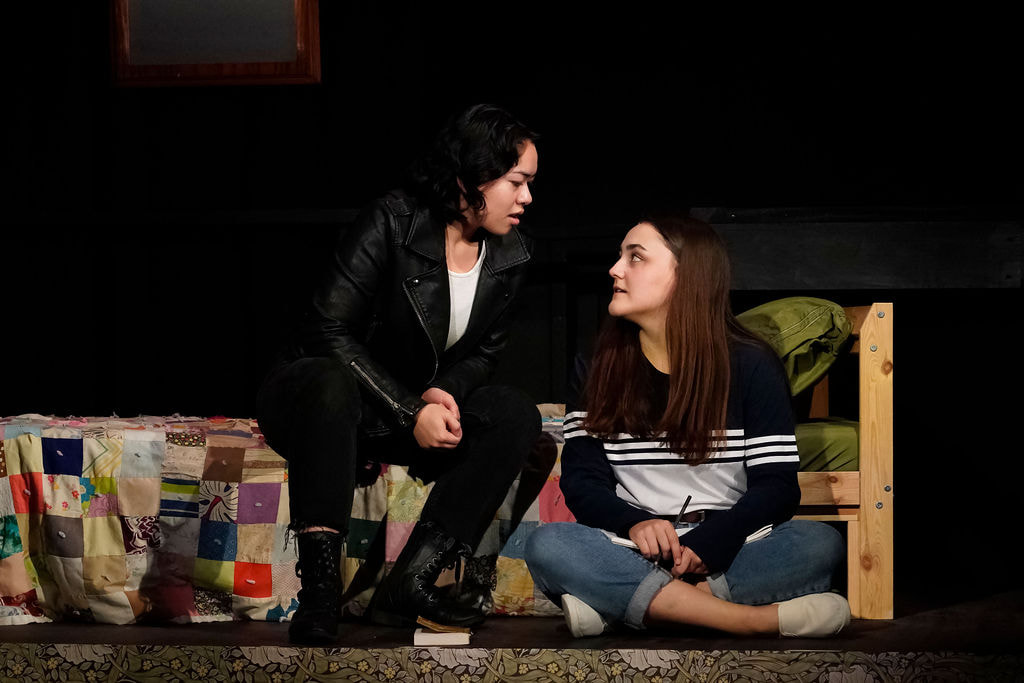 Lisette Velandia (as Joan) and Priya Richard (as Medium Alison) in "Fun Home." Photo by Daren Scott Sometime, somewhere, somebody must have said it out loud in filmmaking, theater-making or television-making circles: You can’t tell a story about a writer if you’re going to show him, her or them writing. For an audience, that’s deadly dull.
So it doesn’t happen very often. But how about a show where we see the cartoonist cartooning AND writing at the same time? It worked for Lisa Kron and Jeanine Tesori, whose “Fun Home,” a stage musical adaptation of cartoonist Alison Bechdel’s memoir won Best Musical and three other Tony Awards in 2015. In their 90-minute show, an actor portraying the current-day Bechdel is onstage throughout with drawing pencil/pen in hand, re-living and documenting in what would be her graphic novel “Fun Home: A Family Tragicomic” the most significant events of her upbringing in Pennsylvania – realizing her own sexual identity and discovering the secrets of her closeted father’s ultimately tragic life. I first saw “Fun Home” in 2018 when it was produced by the bygone San Diego Repertory Theatre with Amanda Naughton as the grown Alison. (Two younger actors play her as a child and as a college student in the show.) I counted it among my Top 10 theatrical productions of that year. Even so, I’d forgotten much of “Fun Home” in the years since, so it’s been fortuitous that there’s a new production onstage through March 3 at New Village Arts in Carlsbad with Kym Pappas directing. “Fun Home” is a frank and at times unsettling tale, though I’m not sure why the folks at NVA believe it’s necessary to announce a kind of trigger warning before the show starts. True, “Fun Home” is considerably more daring than the fare longtime New Village audiences may have enjoyed over the years, but the brave world of good live theater, which this is, is one that all of us should welcome just as bravely. The fact is, though “Fun Home” has its share of darkness, it’s truly an empowering story that Bechdel was compelled to tell in pictures and words, with Kron and Tesori following in her footsteps. The non-linear musical morphs back and forth in time, alternating between Bechdel’s girlhood living among an “ordinary” family of five, and her first year as a student at Oberlin College. “Small Alison” has a complicated relationship with her father, Bruce, who operates a funeral home (this becomes the source of the riffed “fun home” adopted by the three kids). She does not understand why her dad gets into trouble or why he sneaks away in the middle of the night. “Medium Alison,” meanwhile, comes to terms with her sexuality at college and begins a relationship with the kind and confident lesbian Joan. Throughout the parallel storytelling, the adult Alison (smartly played by Rae Henderson-Gray) observes, cartoons, writes and sometimes sings along with her family and younger selves. Now, as in 2018, this device isn’t so much awkward as unneeded. As much as I admire “Fun Home” it seems to me that perhaps having a grown-Alison monologue a couple of times during the show would have accomplished just as much as the presence of the character onstage all the time. What stands out most in “Fun Home,” even more than its pointed story, is Tesori’s music – melodic, stirring and well complemented by Kron’s lyrics. There is potency in “Ring of Keys,” wife Helen’s melancholy “Days,” and both “Telephone Wire” and “Edges of the World” near the end of the show. “Changing My Major,” in which Medium Alison expresses her joyous love for Joan, is funny and touching. The young kids’ “Come to the Fun Home” is what it is – kids singing. At some junctures it sounds like the actors are over-singing, but that may be because the music behind them is just too loud. It doesn’t need to be. The night I saw “Fun Home” at NVA, neither Brent Roberts as Bruce nor Lena Palke as Small Alison, appeared. I’d heard good buzz about Roberts, so I’m sorry I missed him. Henderson-Gray and Sarah Alida LeClair (as Helen) deliver sincere and ardent performances, respectively, with Priya Richard as Medium Alison the most memorable among the cast. This follows her appearance last year in New Village’s exquisite “The Ferryman.” “Fun Home” is a bold step forward for New Village Arts. Its return to the San Diego area after six years is a welcome one. “Fun Home” runs through March 3 at New Village Arts Theatre in Carlsbad. 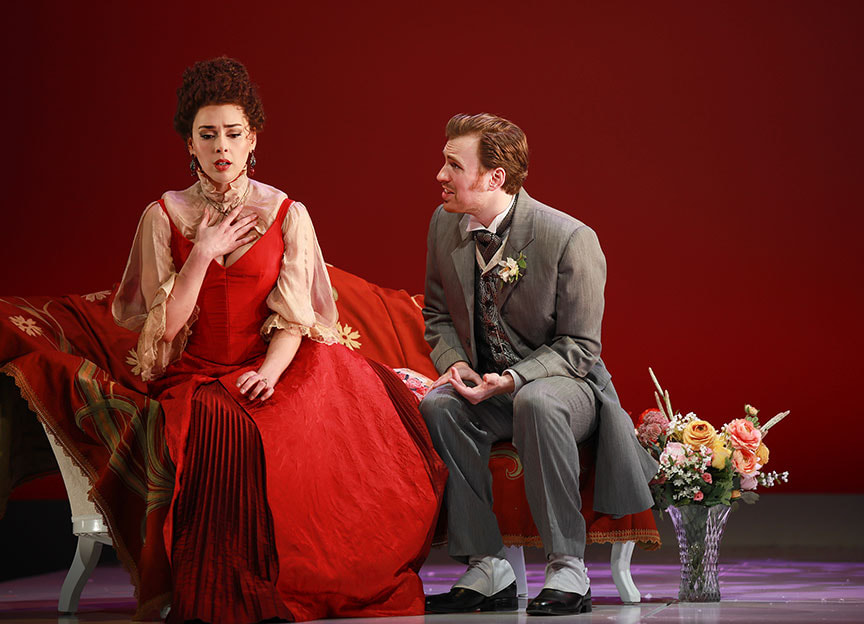 Shereen Ahmed and Callum Adams in "The Age of Innocence." Photo by Jim Cox I wish I’d had a narrator when I had to read Edith Wharton’s “The Age of Innocence” back in college. Especially one like Eva Kaminsky, who in the Old Globe’s production of Karen Zacarias’ adaptation of the 1920 novel not only speeds up the slow-thawing story but provides much needed wit, snark and commentary to otherwise eminently sober proceedings.
As expected, this staging look absolutely fabulous, from Susan E. Mickey’s bustled gowns, flamboyant hats and pristinely pressed suits, to timely and emotive lighting by Lee Fiskness, to the stunning chandelier that hovers over the “Gilded Age” upper-crust society digs of the 1870s. The staging is visually inspired as well. There are few props. Entrances and exits occur in graceful, seeming-slow motion like the painterly figures of the living canvas of “Sunday in the Park with George.” It’s as sedate as a tasteful conversation around a high-society dinner table. “The Age of Innocence,” which won Wharton a Pulitzer Prize – she was the first woman to do so – is a well-known and well-worn tale, popularly adapted before for the stage, for television and for film. Little wonder. As a foredoomed love triangle narrative it’s probably without peer, presuming one’s able to work up genuine empathy for people as privileged and pampered as those in and around the triangle. Newland Archer’s (Callum Adams) betrothal to May Welland (Delphi Borich) is all but preordained, but when May’s cousin, Countess Ellen Olenska (Shereen Ahmad), appears on the scene, having fled her cad of a husband in Europe, Archer’s head is quickly turned and his heart’s desire redirected. There are various complications around this, mostly having to do with the snobbishness and determination to protect stature of the family and acquaintances around these three, but the May/Archer/Ellen entanglement supersedes all. There’s nothing furtive here. The nervous, stammering Archer is fooling no one about where his affections lie. May, though appearing to be passive, not too bright and even saintly, knows the score sooner than anyone expects. Ellen feels the oppression of the elitist tsk-tskers around her, but she knows she’s the brightest star in the society-verse. What Wharton was saying in 1920 about social prejudice and the oppression of women was important and very much with the changing times (women won the right to vote that same year), and this aspect of the ironically titled “The Age of Innocence” should not be dismissed lightly. Regardless of whether Ellen Olenska chose to live her life independently of those who judged her (or loved her) because she was asserting her self-determination or sparing her cousin’s feelings, she is a worthy literary heroine. If this is starting to sound more like a book review than a theater review, mea culpa. But “The Age of Innocence” the novel has more heft than does this new production at the Globe. In Martin Scorsese’s 1983 film adaptation, Joanne Woodward provided narration, mirroring Wharton’s observational storytelling in the novel. In the Globe’s world-premiere staging, Kaminsky, wearing contemporary clothes, puts much of the lovers’ foibles and machinations into sharp perspective. At times she’s telling us things that we can see on stage, but often she’s enlightening us about what we don’t see but should. Chay Yew, a superior director (the Globe’s likable “Dishwater Dreams” last year, La Jolla Playhouse’s wonderful “Cambodian Rock Band” in 2019), demonstrates his respect for the original material here and his “Innocence” cast is studied and dignified. Ahmed commands every scene she inhabits, even without speaking -- as the captivating but troubled Count Olenska should. I know a few people who saw “The Age of Innocence” on Valentine’s Day, the evening of its last preview. For them, the lingering moment when Archer and the Countess silently share a carriage with their unspoken longing and torture between them must have seemed like romance at its at-once most beautiful and painful. “The Age of Innocence” is no swooning valentine, though -- nor is it innocent. The realities that keep lovers apart may shift and change as the decades go by but they persist in their power to cause loneliness, whether in an elegant salon full of swells or in an empty bedroom. “The Age of Innocence” runs through March 10 at the Old Globe Theatre in Balboa Park.  Left to right: Deja Fields, Marcel Ferrin, DeAndre Simmons and Justin Lang in "Clyde's." Photo by Daren Scott Order up! Metaphor with melted gruyere and garlic aioli on ciabatta bread!
That could well be Lynn Nottage’s one-act comedy “Clyde’s,” in which a sandwich represents almost anything except a sandwich. For the formerly incarcerated kitchen crew at Clyde’s truck stop diner in Pennsylvania, pursuit of the perfect sandwich is a matter of personal expression, pride in oneself and healing. If the sandwich is a doubledecker metaphor in “Clyde’s,” that can be forgiven, for a couple of reasons. For one, the sandwiches brainstormed and in some cases concocted by Montrellous, Letitia, Rafael and Jason are reflections of their distinctive personalities even as they share the lingering pain of having been in prison (and for different reasons, how they got there in the first place). For another, some of the sandwiches described sound so delicious, this show’s guaranteed to incite your appetite. Moxie Theatre is staging “Clyde’s” under the direction of Delicia Turner Sonnenberg, the company’s co-founder and original artistic director. When it comes to directing a production with as many moving parts and intertwining relationships as this one has, and to realizing onstage the work of Lynn Nottage, no one does that better than Turner Sonnenberg. She previously directed the playwright’s “Crumbs from the Table of Joy” at Moxie 10 years ago, and Nottage’s “Intimate Apparel” at the San Diego Rep in 2006. Set in a meticulously realistic kitchen designed by Michael Wogulis that includes many appliances and tools on loan to Moxie, “Clyde’s” is a character study constantly in motion. There’s sandwich making, supply restocking, drizzling of ingredients, snatching of order-pad sheets from a window, mopping up … none of which ever intrudes on the interactions between the kitchen staff doing their first jobs out of the joint, and doing their damnedest to survive. Montrellous (a resonant DeAndre Simmons) is Clyde’s philosopher-king, a gentle man who has raised the art of the sandwich to fine art. Single-mom Letitia (Deja Fields) is making ends meet while relying on fire and spirit. Rafael (Marcel Ferrin) is sweet and sweet on Letitia. Jason (Justin Lang) is a return character from Nottage’s “Sweat,” at first estranged from the others but quickly accepted by them in spite of the barely suppressed darkness within him. As in the best successful stories, the denizens of Clyde’s little kitchen become people whose fates we care about – underdogs who are desperate for a second chance at life and who, while whipping up sandwiches, share hopes they otherwise might not have dared to hope for. Then there’s Clyde herself (Tanya Alexander), the embodiment of all the bitterness, resentment and ire that life’s hard knocks and incarceration can beat into a person. Confrontational and verbally abusive, she visits the kitchen to deride and declare war on hopes and dreams. Designer sandwiches? These are truckers! They want truck stop food! Worse: “You’re all losers.” Clyde and Montrellous are polar adversaries, and at junctures she seems too bad to be true and he too good to be true. But notably in the case of the Montrellous character, Nottage’s script will make clear that there is another, guarded depth of emotion swelling inside. The Moxie cast one and all is standout, with each actor enjoying at least one (and some many more than one) scenes to elucidate his or her character. There are moments of confession, desperation and anger, but also tender gestures here and there that remind us of each ex-inmate’s humanity. Nuances of lighting (by Annelise Salazar) and snippets of music (sound design by Harper Justus) make the Clyde’s kitchen more than just a workplace. We can imagine that the unseen side of Clyde’s – where the truckers weaned on ketchup and pickle relish pull up a stool to chow down – is something else entirely. Performances from Fields and Lang in particular, along with some genuine laughs amid the baring of soul that runs through “Clyde’s,” mark this as quite possibly the best production at Moxie since Desiree Clarke Miller assumed the role of artistic director. It also testifies to the remarkable writing talent of Lynn Nottage whose intuition about people striving for a better life is uncanny. “Clyde’s” runs through March 10 at Moxie Theatre in Rolando. 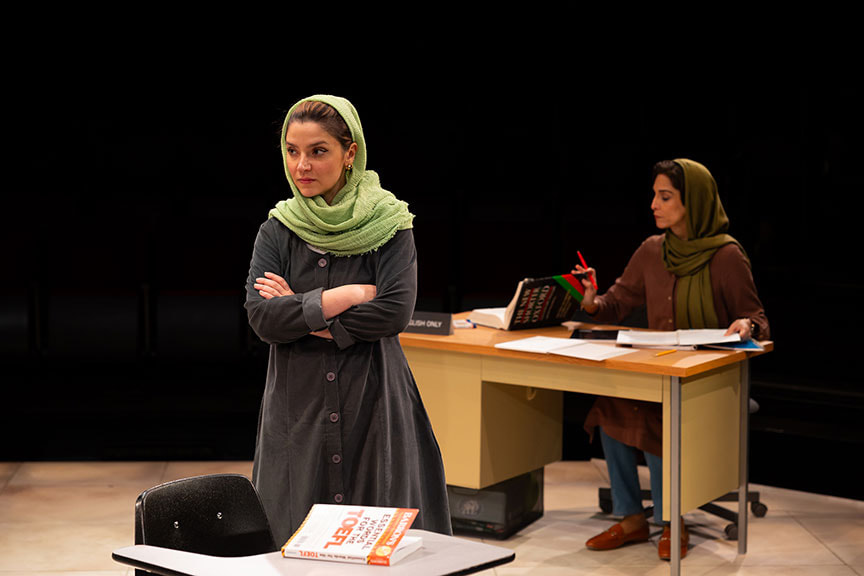 Tara Grammy (left) and Pooya Mosheni in "English." Photo by Rich Soublet II It’s been said that for someone who doesn’t speak it to begin with, English is the hardest language to learn. For a small group of students in Karaj,near Tehran, preparing to take the TOEFL exam, the degree of difficulty is much more profound than mere pronunciation, syntax or the art of conversation.
A deserved winner of the Pulitzer Prize for Drama last year, Sanaz Toosi’s “English” addresses with intelligence and ferocity the quandary of assimilation: Is learning to speak English for the benefit of a “better life” worth the sacrifice of one’s cultural identity … indeed one’s self? The Old Globe is staging “English” in its theater-in-the-round White space, which challenges the expectation of a traditional classroom setting, but as the actors are on their feet much of the time, it’s not an impediment. Directing this show, which proceeds largely in quick mini-scenes, is Arya Shahi, a founding member of New York’s Pigpen Theatre Co. His work is no stranger to the Globe: Shahi was part of the ensemble that staged “The Old Man and the Old Moon” and “The Tale of Despereaux” in the main theater in 2017 and 2019 respectively. He’s got a skilled and sympathetic cast to work with. Iranian-American actor/writer/activist Pooya Mohseni presides as Marjan, who’s teaching the four students and absolutely insisting that “ENGLISH ONLY” be spoken in the room. Playwright Toosi’s world is one in which the actors speak with halting accents when practicing their English for Marjan and with each other; when speaking normally it is implied that they are conversing in their native language, Farsi. It’s probably the only way this could have been done, as few audience members are likely to be conversant in Farsi themselves. The most strident and definitely blunt of the students is Elham (Tara Grammy), who is preparing to take the TOEFL (Test of English as a Foreign Language) exam for the fifth time. Elham is frustrated by the slow progress of the other students, resentful of the flirtation between the one male pupil, Omid (Joe Joseph) and teacher Marjan, and increasingly bitter about being asked to lose herself in another language, if not another culture, at the expense of her own. The oldest of the students, Roya (Mary Apick) is struggling the most with learning English and it may be because she truly doesn’t want to. After all, her son has moved his family to Canada, given himself a non-Iranian-sounding name, and done so too with her grandchild. A running dilemma early in the going is Roya’s futile attempts to get him on the phone. Apick is a highly accomplished film and television star in Iran, and that experience resonates in a performance that is completely affecting in both its anger and heartbreak. The aforementioned Omid is a mystery to his fellow students – his English is already beyond proficient, and there’s a smugness about him that tends to repel all but Marjan, who it is believed has an unfulfilling marriage and perhaps the same kind of life outside the classroom. Joseph is certainly capable in the role, though to me the flirtation side-story feels superfluous – at least until it precipitates some important revelations near the end of the story. Ari Derambakhsh is utterly charming as the youngest student, Goli, though her part among all of them seems underwritten. Most of the dramatic tension of “English” simmers in the encounters between Marjan and Elham, right down to the denouement of the play. To some extent they represent both sides of the all-but-institutionalized “you’ve got to speak English to get anywhere” mentality. For Marjan, aptitude in if not mastery of English is entry into another, more promising world. For Elham, learning the language, passing the test, must be done. Period. But she will cling to the world she grew up in, the world she knew. To do otherwise would be to betray herself. There’s a plum at the very end of the play, which I won’t spoil. I will say this – it represents a moment of validation for Elham and for anyone else who cherishes what they know and care about the most, anyone who is ardently willing to learn but just as ardently unwilling to compromise. “English” runs through Feb. 25 in the Old Globe’s Sheryl and Harvey White Theatre in Balboa Park. 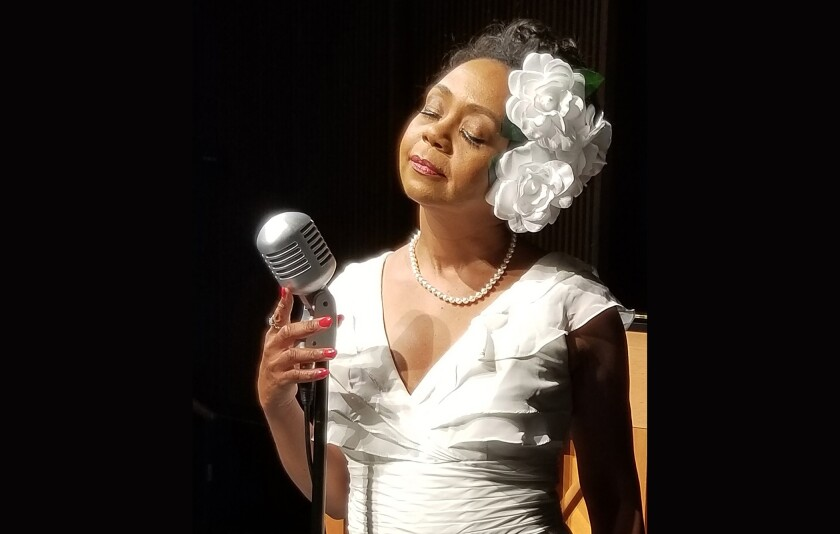 Karole Foreman as Billie Holiday in "Lady Day at Emerson's Bar & Grill." Photo by Craig Schwartz Memo to GOP presidential candidate Nikki (“We’re not a racist country. We’ve never been a racist country.”) Haley: You need to see – and hear – “Lady Day at Emerson’s Bar & Grill.”
Lanie Robertson’s play with music, which imagines the legendary but troubled Billie Holiday performing in a South Philly bar late in her career, is quite amazingly more about what Lady Day says than what she sings. During the course of a real-time-seeming hour and a half set, drinking and smoking the while, her composure gradually deteriorates – but not her memory of the cruel treatment she received as a Black woman, even one who was a hailed musical star. Her recollection of these atrocities in all their ugliness can turn a theater stone cold silent. As it did in moments at Cygnet Theatre, which in association with L.A.’s Ebony Repertory Theatre, is presenting “Lady Day at Emerson’s Bar & Grill.” Actor/vocalist Karole Foreman is a veteran of this role, having starred in “Lady Day at Emerson’s” four times prior to this staging. Her performance is seamless in what has to be a physically and emotionally grinding part – and at Cygnet, she does two shows on Saturdays during this run yet. Accompanying her on piano is Damon Carter as Jimmy Powers, friend-in-charge of keeping the set on track and to some extent keeping her upright. Striking in a white dress and in the latter part of the show with Holiday’s familiar gardenia pinned to her hair, Foreman does not try to reproduce Lady Day vocally, though if you know the jazz great’s catalog, you’ll hear her distinctive phrasing just as it sounded on records. Early in the going, when rendering “I Wonder Where Our Love Has Gone” or “When a Woman Loves a Man,” Foreman’s Billie is poised at the mic stand, an established pro. As the imaginary evening progresses, her asides and painful stories supersede the musical performances: songs become fits and starts; Jimmy has to cue her at the keyboard to kindly but firmly interrupt the meanderings; trips to a table where the booze waits to be poured and the lighting of cigarettes increase. Here’s where we return to that memo for Nikki Haley and anyone else who chooses to look the other way on America’s shameful racial history. Robertson’s script pays heed to Holiday’s substance abuse, domestic abuse and legal struggles, but rightly emphasizes the terrible prejudice Billie Holiday endured. One recollection onstage in particular, about touring with Artie Shaw’s band and being denied in a White venue basic access to a restroom, is the saddest and most infuriating, even as Lady Day ends the story with her uproarious act of revenge. Maybe this doesn’t need saying, either, but when Foreman returns to the microphone to sing “Strange Fruit” (Foreman called that “the first protest song” in an interview she did with me for the San Diego Union-Tribune), it is a chilling, time-just-stops moment. The heaviness of this show, which was first staged in the ‘80s, does not completely detract from the music. We hear “Easy Living” and “Somebody’s On My Mind,” “T’ain’t Nobody’s Business If I Do” and of course “God Bless the Child.” Foreman and Carter make a wonderful team. I first saw “Lady Day at Emerson’s Bar & Grill” at ion theatre in 2015, with Cashae Monya starring. The size of ion’s tiny venue at Sixth and Pennsylvania in Hillcrest necessitated ingenuity of staging, and converting the place into a cabaret, complete with little tables and chairs, resulted in a “Lady Day at Emerson’s Bar & Grill” that Robertson probably envisioned from the start. At Cygnet, where the show is directed by Ebony Rep’s Wren T. Brown, Foreman is close to the audience and she does step down to walk among the front-row theatergoers here and there, but it’s still a conventional performance space, and the cabaret effect is never fully achieved. Even so, the more people who hear again (or for the first real time) the musical brilliance of Billie Holiday and, more important the tragedies and little triumphs of her life, the better. You could fill 10 SoFi Stadiums with this show and still have so many people who need to know about and hear the unforgettable Lady Day as perhaps she was on some dive-club night before she left the world. “Lady Day at Emerson’s Bar & Grill” runs through Feb. 18 at Cygnet Theatre in Old Town. 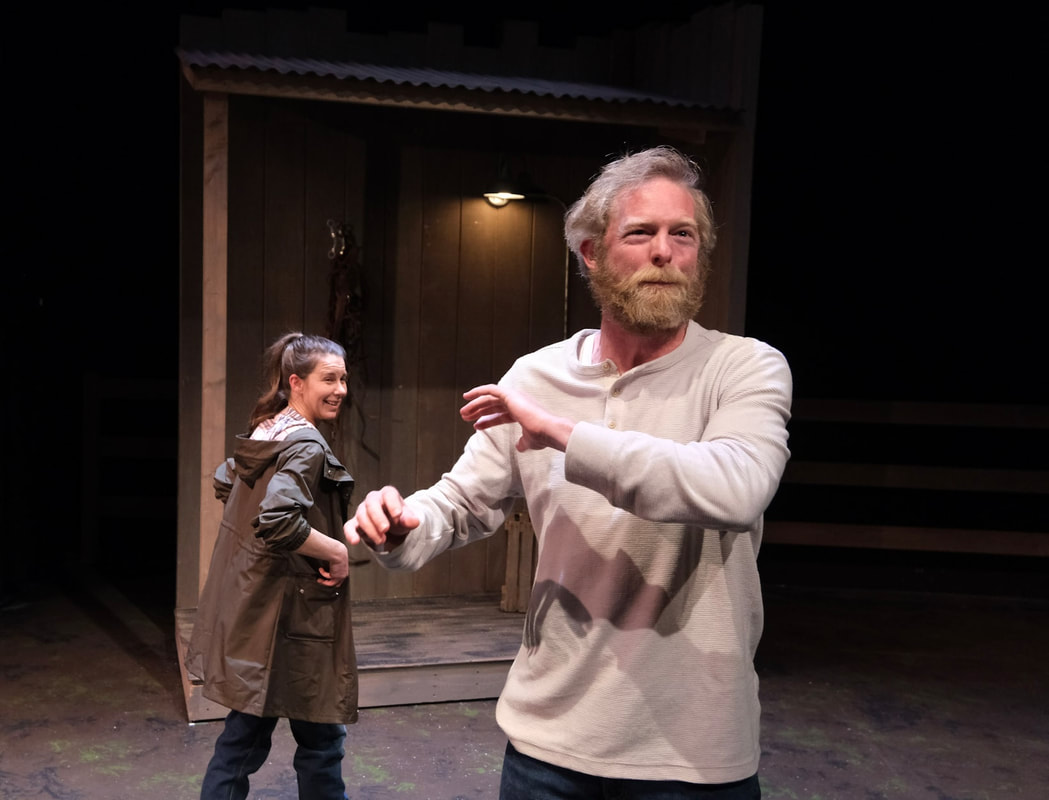 Brian Mackey and Rachael VanWormer in "Outside Mullingar." Photo by Ken Jacques Brian Mackey at his best distinguishes Lamb’s Players Theatre’s production of John Patrick Shanley’s “Outside Mullingar,” an atypically non-grim Irish story that in the end becomes a quirky romantic fairytale.
With an almost endearing nervous energy of the kind that accompanies (we will find out) a secreted neurosis, Mackey portrays Anthony Reilly, the 40ish son of an ailing farmer, both of them residing outside Mullingar in County Westmeath, Ireland. In Shanley’s tale inspired by his very first trip to Eire more than 30 years ago, Anthony’s anxiety gets immediately ramped up when his father, played on the night I saw “Outside Mullingar” by Robert Smyth’s understudy, the very capable Eddie Yaroch, reveals that he does not intend to leave the farm after his death to his son. “You don’t love farming!” is the accusation, though as events unfold it’s learned that this is a smokescreen. At Lamb’s the 10-year-old “Outside Mullingar” is being collaboratively directed by Smyth, Kerry Meads and Deborah Gilmour Smyth, who also appears as Aoife Muldoon, a neighboring farm owner and at the outset of the play just widowed. Completing the cast is Mackey’s spouse, Rachael VanWormer, as Rosemary Muldoon, Aoife’s headstrong daughter who’s been waiting for decades for Anthony to woo her. (This in spite of the fact that she still resents his knocking her down when she was a child.) So you’ve got two pairs of spouses in this production: Smyth and Gilmour Smyth, and Mackey and VanWormer. As noted above, Yaroch was understudying Saturday night so I wasn’t able to observe the Smyth/Gilmour Smyth dynamic, though I hardly needed to. They’ve performed together more than 30 times. Mackey and VanWormer are a fine onstage match, particularly in the play’s latter half when the story shifts from the disconnect between Anthony and his father to the descendants left behind after the elders’ passing. Leading up to its startling reveal, “Outside Mullingar” drops hints and clues and gems about where its deceptively linear story is going, most of these not understood until after that reveal itself. Shanley could be accused of trying to be too cute with this play, and many, as I was the first time I saw it years ago, will be slightly if temporarily aghast at the turn “Mullingar” takes. But by the time the show is winding down, hankies may be necessary. Among his strengths in this production is Mackey’s mastery of and commitment to the Irish accent he employs – it never wavers. In a small part, Gilmour Smyth does the same. As the fiery and understandably frustrated Rosemary, VanWormer’s Irish occasionally gets lost in her consternation, but she enjoys multiple moving moments in the part. Yaroch’s a bit one-note, his grudges grumbled, his stubbornness stolid, though his last scene with Mackey feels genuine and is touching. There are quite a few laughs in “Outside Mullingar,” some no doubt incited by sheer astonishment, but I wouldn’t call it a comedy. Nothing as profoundly Irish as a play set near a village called Killucan can escape a certain broodiness. Still, Shanley wrote the screenplay for “Moonstruck,” so he knows how to write humor. And romance. And family. He can be forgiven for teasing us possibly too much in “Outside Mullingar” – or maybe he should be applauded for doing so. “Outside Mullingar” runs through Feb. 18 at Lamb’s Players Theatre in Coronado. 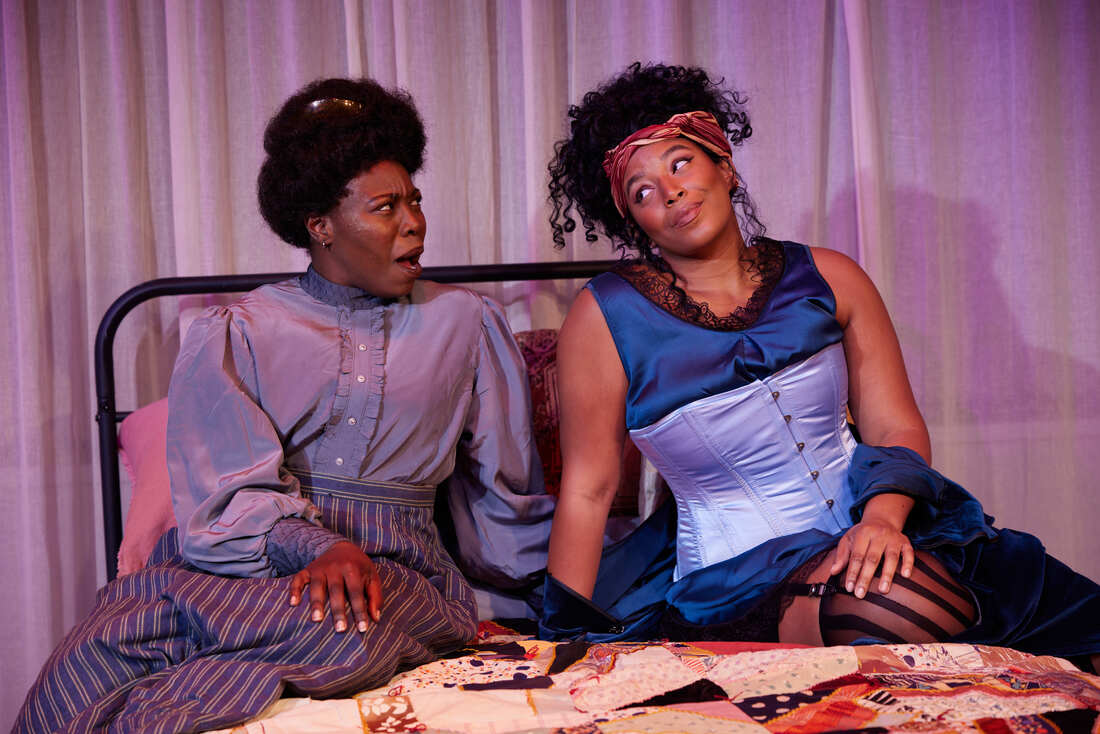 Nedra Snipes (left) and Arizsia Staton in "Intimate Apparel." Photo by Aaron Rumley There’s a very good reason that Lynn Nottage’s “Intimate Apparel” more than 20 years on is so frequently produced today: It’s a graceful, meticulously written play with rich characters and the craftsmanship to touch the heart without sinking into sentimentality. In North Coast Repertory Theatre’s fine production of “Intimate Apparel” too, its protagonist Esther Mills, owing to direction by Jasmine Bracey and a sensitive performance by Nedra Snipes, defies victimhood even as betrayal and broken dreams threaten her resolve.
“Intimate apparel” is what 35-year-old Esther, a Black woman residing in a lower Manhattan boarding house in 1905, creates on a humble sewing machine for clients like the wealthy and White Mrs. Van Buren (Madeleine Barker). It’s a steady business and Esther takes great pride in her handiwork, but she is lonely and dares to dream of love. When long-distance correspondence with a worker named George Armstrong in Panama begins via letters, hope springs for Esther. Uneducated, Esther can neither read nor write, so assistance reading and writing her letters back to George comes from Mrs. Van Buren, whose own loneliness begins to show early on and who craves the vicarious romancing, and from Esther’s friend Mayme (Arizsia Staton), a flamboyant prostitute masking her own disillusionment with vivacity. Also in Esther’s small sphere are Mrs. Dickson (Teri Brown), who operates the boarding house and thinks – is certain that! – she knows better than Esther, when it comes to just about everything. And Mr. Marks (Jonathan Fisher Jr.), the sweet Romanian Jewish man in the neighborhood who sells wonderful and affordable fabrics to Esther. Their scenes together, throughout, are tender and lovely. As is somewhat predictable, when George Armstrong (Donald Paul) comes to America, meets and quickly marries Esther, he turns out to be not what she was led to dream he’d be in his letters. He is, and there’s no other word to say it better, a cad. Rife with opportunities to overplay their hands one and all, the North Coast Rep cast never does. Even Staton, in a role that could easily morph into caricature, brings out Mayme’s humanity and the depth of her friendship for Esther in a well turned performance. Her intentionally off-key vocals at the piano speak to Mayme’s sense of fun even in a sadly dissolute life. In the same way, Fisher’s fabrics seller is understated in its sincerity and goodness. He represents for Esther, as Nottage no doubt intended, a stark and aching contrast to the morally bereft George. Snipes strikes all the right chords as Esther – vulnerable but not weak; diffident but not naïve; certainly not worldly, but intuitive. In an interview I did with her for the San Diego Union-Tribune, director Bracey told me that Snipes had “a remarkable sense of who Esther is.” Agreed. A set for “Intimate Apparel” probably requires no more than a sewing machine, a bed and a scrim, and the North Coast Rep’s is just about that save a proscenium-wide drapery rather than a scrim. In truth, this play could be staged with no set at all – ok, maybe the bed – and sacrifice none of its dramatic effect. Really, all that’s needed are Nottage’s words and a skilled cast to speak them. Done. “Intimate Apparel” runs through Feb. 4 at North Coast Repertory Theatre in Solana Beach.  Green is all the rage in "The Wiz." Photo by Jeremy Daniel Consider the production number that opens Act II of “The Wiz”: The setting is an Emerald City night spot, The No Sleep Club, bathed in oscillating green. There, in full throttle, pulsating dance and high-octane vocals, an Ozian ensemble to music by Timothy Graphenreed frolics as if in one of those Vegas hotspots where the price of bottle service alone is strictly for high rollers.
This is not your grandmother’s “Wizard of Oz.” You can say that this number, “The Emerald City,” has very little to do with the well-known L. Frank Baum story of Dorothy Gale and her pals the Scarecrow, Tin Man and Cowardly Lion, and you’d be right. But “The Wiz,” which opened 50 years ago before moving to Broadway in 1975 and was subtitled “The Super Soul Musical ‘Wonderful Wizard of Oz’”, was never intended to be a note-by-note retelling of Baum’s tale, or of the beloved 1939 Judy Garland film. In fact, take out “The Emerald City” completely and “The Wiz,” which is on a national tour now at the Civic Theatre downtown presented by Broadway San Diego, is still a hipper, less sentimental and much funnier iteration of its ancestral sources. That’s not to say I don’t cherish the MGM film – who doesn’t? Try to think of “The Wiz,” if you haven’t seen it or the 1978 movie adaptation with Diana Ross and Michael Jackson, as a reimagining of the well-known “Oz” tale. There’s room in our cultural archives for all takes on Baum’s 1900 book. (Well, maybe not James Franco’s silly “Oz the Great and Powerful” prequel film.) This touring production of “The Wiz,” which was created by William F. Brown (book) and Charlie Smalls (music and lyrics) features additional material by comedian/actress and writer Amber Ruffin, who’s likely ramped up the humor of the show, and it had considerable to begin with. What’s always been notable about “The Wiz” to me is that its songs, so completely different from Harold Arlen and “Yip” Harburg’s in 1939, possess their own charm and musicality. Small’s version of “Follow the Yellow Brick Road,” “Ease On Down the Road,” is practically a standard today; the closing “Home” is a lovely ballad; and the personality-defining ditties given the Scarecrow, Tin Man and Cowardly Lion are fun enough without being at all derivative. On this tour, Nichelle Lewis is a forthright Dorothy and a performer with a potent voice. She’s the anchor among a rubbery Avery Wilson as the Scarecrow, Phillip Johnson Richardson as the Tin Man (the finest of the supporting actors) and Kyle Ramar Freeman in the can’t-miss costume of the Lion. Melody A. Betts takes no prisoners – well, actually she does take Dorothy prisoner, but I’m talking performance-wise – as the Wicked Witch of the West, in “The Wiz” called Evillene. As The Wiz, Alan Mingo, Jr. is good fun and a vital force in all the Emerald City production sequences. It’s great to see Deborah Cox, so memorable on the Civic Theatre stage in 2017 in “The Bodyguard,” playing the most dazzling Glinda you’ll ever see. She gets two numbers – “He’s The Wiz” and “Believe In Yourself” and knocks both out of the park. The story of “The Wiz” does not depart significantly from traditional “Oz” tellings, but some of the plot developments unfold without much buildup or even logic. Maybe that’s because we all know how it turns out anyway. More or less. It’s the staging of this show that is more noteworthy. The way, for example, that spinning dancers are employed to “portray” the tornado that sweeps Dorothy’s house off the Kansas ground. Both Hannah Beachler’s prodigious scenic design and Sharen Davis’ wildly colorful yet functional costumes give “The Wiz” its flash and dash, and Jaquel Knight’s choreography has a breathless, contemporary feel to it. Even with all its energy, “The Wiz” is lengthier than it probably needed to be, but come on – you don’t go from the Kansas plains to Oz and back in 90 tidy minutes. “The Wiz” runs through Jan. 14 at the Civic Theatre, downtown. 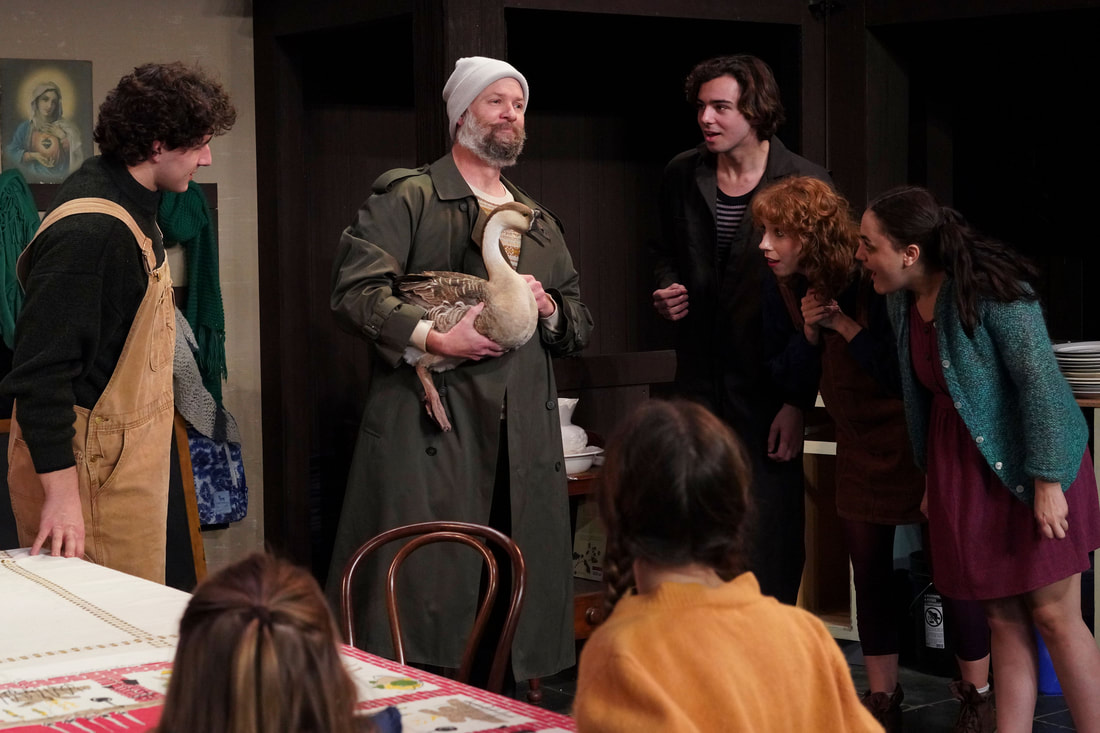 Men, women, even a goose: all part of New Village Arts' "The Ferryman." Photo by Daren Scott Please. Don’t give me that “Theater’s dying” talk. As more than one purveyor of the craft has told me this past year when I float that doomsday scenario, theater’s been “dying” for years, yet here we are. If you want to reduce this noblest of performing arts to mere ticket sales, dollars and cents, and butts in the seats, go ahead and make your case.
I’m not going there. If 2023, arguably the first full post-pandemic year of live theater, is any indication, there is life … and bursting creativity … and inspiration … and, hovering over even the darkest of dramatic productions, joy onstage. That goes for behind the scenes and in the stalwart hearts of theater makers everywhere. This means you too, San Diego. Especially you. Selecting the top 10 productions of any year is daunting. So it is with 2023. For what it’s worth, I don’t pretend to be all seeing or all knowing. I do know what moved me, what entertained me, what stirred my imagination and rattled my conscience the most, and these are reflected on this list. Theater is alive. Here is proof. 1. “The Ferryman,” New Village Arts Theatre. When I reviewed this incredibly ambitious production way back in January I wrote that it was practically Shakespearean in scope: Multiple intertwining plot lines. A cast of 21 including those portraying the 14 members of the Carney family of County Armagh (one of them a baby). Live animals. But “The Ferryman,” written by Jez Butterworth and directed by NVA’s Kristianne Kurner, was more than about scope. Its deep dive into the Irish troubles and family dynamics, and how they intersected in time, was captivating. Yeah, it was over three hours’ long with two intermissions. So what? 2. “August: Osage County,” Backyard Renaissance Theatre Company. Start with a deservedly Pulitzer-winning drama by Tracy Letts. Add as close to an all-star cast as any local production this year has enjoyed. Top it off with one of the supreme performances of ’23 – Deborah Gilmour Smyth as drug-addled family matriarch Violet Weston. Backyard Renaissance delivered a stellar season with this collective tour de force, the acidic comedy “Gods of Carnage” before it and the thoughtful “Proof” a month ago. Its “August” compared favorably to the production the Old Globe did back in 2011. Edge-of-your-seat theater in intimate confines. 3. “The Outsiders,” La Jolla Playhouse. I was not a fan of the 1981 Francis Ford Coppola film, and I hadn’t read the original novel by S.E. Hinton from the ‘60s, so I didn’t quite know what to expect when the Playhouse world-premiered this show with a book by Adam Rapp and music by the rootsy Jamestown Revival. What a wonderful surprise. “The Outsiders’” coming-of-age tale set in a dusty, bygone Tulsa was beautifully conceived, musically affecting and acted with no pretense at all by a young and talented cast. “The Outsiders” is set to open on Broadway in April. It earned that opportunity, no matter what happens in the Big Apple. 4. “Public Enemy,” New Fortune Theatre Company. This is the only production on this list that I saw twice. Even when I knew what was coming the second time around, I felt the anxious tension in my neck and shoulders that only a fiery adaptation (by David Harrower) of Ibsen’s “Enemy of the People” could elicit. Most of the credit for that goes to New Fortune Artistic Director Richard Baird, who starred as the well-meaning then betrayed Dr. Thomas Stockmann. Like Gilmour Smyth’s in “August: Osage County,” Baird’s performance was physically and emotionally, no-holds barred astounding. 5. “Birds of North America,” Moxie Theatre. Were I to name a Director of the Year it would be Lisa Berger, who was at the helm of this gentle and thoughtful production as well as Diversionary Theatre’s “The Glass Menagerie,” which I’ll discuss a bit later. Anna Ouyang Moench’s “Birds of North America” found a disconnected father and daughter (Mike Sears and Farah Dinga, both first rate) working out their issues about each other while birding. The wooded scenery backdrop by Robin Sanford Roberts and Matt Lescault-Wood’s extraordinary sound design transported audiences to a special, private place in nature and in the heart. 6. “El Huracan”, Cygnet Theatre. Performed in both English and Spanish, Cuban-American Charise Castro Smith’s metaphorical play articulated the desperation of loss: of a woman’s memory and, in the bigger picture, of hope. Hurricane Andrew in 1992 in Miami (to this day still the most destructive storm to ever hit Florida) was the backdrop for a family tale that was frequently heartbreaking even as it found joyous escapism in moments like a flashback of dancing to Sinatra at the Tropicana Club in Havana. Cygnet’s marvelous cast included Catalina Maynard, Sandra Ruiz, Amalia Alarcon Morris and Carla Navarro. 7. “Sunday in the Park with George,” CCAE Theatricals. At the California Center for the Arts, Escondido’s 400-seat Center Theater Stephen Sondheim and James Lapine’s daring bio-musical about pointillist painter Georges Seurat unfolded as it was intended to, with his painting “A Sunday Afternoon on the Island of Grande Jatte” coming alive before your very eyes. Broadway veteran Will Blum was sublime as Seurat in the superior Act I, complemented by the versatile Emily Lopez. The technical wonderwork: from scenic designer George Gonzalez, costumer Janet Pitcher, projectionist Patrick Gates and lighting designer Michelle Miles. 8. “La Lucha,” La Jolla Playhouse. The year’s most immersive theater experience had to be this production created for rooms inside the Museum of Contemporary Art San Diego Downtown by designer David Israel Reynoso and Optika Moderna. Inspired by the culture of lucha libre masked wrestlers, the hourlong “La Lucha” walking experience challenged the senses --and both cultural and gender expectations-- in startling ways. The luchadores masks worn by the actors and the meticulous rooms’ set pieces enhanced the dreamlike atmosphere inside the MCA building on Kettner as well as a palpable sense of love, death and magic. 9. “The Glass Menagerie,” Diversionary Theatre. Still playing (through Dec. 23) at the University Heights LGBTQIA+ theater, Tennessee Williams’ devastatingly sad family tale, much of it purported to be autobiographical, is a master class in inhabiting a character from Shana Wride, portraying the domineering, self-deceived matriarch Amanda Wingfield. Luke Harvey Jacobs is tortured Tom, the story’s narrator. According to director Lisa Berger, Diversionary’s is a collaborative interpretation of “Menagerie” in which Tom is closeted and daughter Laura (Julia Belanova) othered. If so, it seems very, very subtly executed. 10. “Lonely Planet,” OnStage Playhouse. If the future of Chula Vista’s OnStage Playhouse is unclear at this writing, it can be nonetheless duly proud of this sensitive staging of Steven Dietz’s AIDS-era play. Onetime OnStage artistic director Teri Brown directed her successor, James P. Darvas, and Salomon Maya as friends navigating the fear and loss of the epidemic in very different but intertwined fashion. In the small OnStage space, the raw emotions loosened inside what’s supposed to be a scarcely patronized map store (designed to fine detail by Patrick Mason) are all the more chilling. Honorable mention: “Sumo,” La Jolla Playhouse, “Normal Heights,” Loud Fridge Theatre Group, “Gods of Carnage,” Backyard Renaissance Theatre Company, “Sharon,” Cygnet Theatre, “Head Over Heels,” Diversionary Theatre. FOOTLIGHTS FOOTNOTES • A highlight of my theater year was attending a production at the famed Steppenwolf in Chicago. While “Another Marriage” by Kate Arrington was neither as funny nor as tender as it aspired to be, the Lincoln Heights theater itself boasts energy and a definite hipness quotient. • Fond adieus and good jobs well done to Matt Morrow and Jennifer Eve Thorn who departed the theaters for which they were artistic director, Diversionary and Moxie respectively, this year. • This year marked the debut of the San Diego Theatre Critics Circle’s first podcast, “Downstage,” which I co-hosted with colleague Alejandra Enciso-Dardashti. We had a lot of fun over the course of 12 episodes and enjoyed the presence of many enlightening guests. Looking forward to more “Downstage” in 2024, beginning early in the year with a preview of the SDCCC’s Craig Noel Awards (to be handed out on Feb. 12). • The boorish behavior of Rep. Lauren Boebert at a Denver theater in September exemplified the ever-increasing audience misbehavior at live performances. While the congresswoman’s vaping and groping was an extreme manifestation of this, I witnessed in theaters many times this year audience members talking, looking at or lighting up their phones, wearing big floppy hats to block others’ views and in one case drunkenly babbling while a serious drama was unfolding onstage. Call me a scold if you will, but enough is enough. • To end on a positive note, a salute to a couple of fledgling San Diego companies that distinguished themselves in ’23 and demonstrate promise for the years ahead: Loud Fridge Theatre Group and Blindspot Collective. That’s it, everybody. Curtain. |